

Experimenting with how to release music in ways that feel deeper than just posting links has become my north star, and I’ve ended up building a small game to go with my new single ‘I Wanna Get Back.’
It’s a simple experiment in world-building and connection — made entirely by me, using the same curiosity that drives my music. You can play it now, and read about what I learned making it below.
I’m always thinking a lot about how we release music.
For years, we have followed the same processes for every release, and as we have lived more online, that cycle, for me at least, has become boring: pre-save, out now, post, stream, repeat. After feeling burnt out by my SCENES project, I’ve now ended up back again finding that aiming for reach is much less rewarding, than aiming for depth.
So, over time I’ve become more hungry for new ways to make what I do feel more interesting, which has led to : what if every song could be the start of a world instead of just another posting run.
World-building, for me, has become a way of turning songs into something I care about more, when it started as a way to get others to care more. It’s about building more meaningful connections with the people who care, while experimenting with new mediums that carry the emotion further, or teach me something about myself. The story and the world around my music has always been really important, but I admittedly in the past kept in the safe confines of artwork and videos and other mediums that were the norm. By taking those skills that I had used just for music, and learning to let them it feed into other mediums, I hope it leads people back to my music and maybe inspired others to give something new a try.
From SCENES to now
When I made SCENES, I wanted to prove that music could be more than audio.
It became a participatory album where listeners contributed memories that turned into artworks and postcards.


That project showed how powerful it can be when people are not just an audience but co-authors.
But it also revealed a limitation. I needed funding and developers to make it happen.
I loved what we built, but I couldn’t do it alone. And getting it to scale was harder than I expected… that expectation I put on the project ended up making it harder to enjoy, as I couldn’t see the value it brought at the time, as my mind was programmed to look for success markers in the wrong places.
So I started wondering what would happen if I tried to build the next world myself, using today’s tools, curiosity, and no team. To see what I could do, and learn in the process.
We have seen campaigns like BRAT dominate music, but can world building around music in this way look like on a small independent scale?
The next experiment: I Wanna Get Back
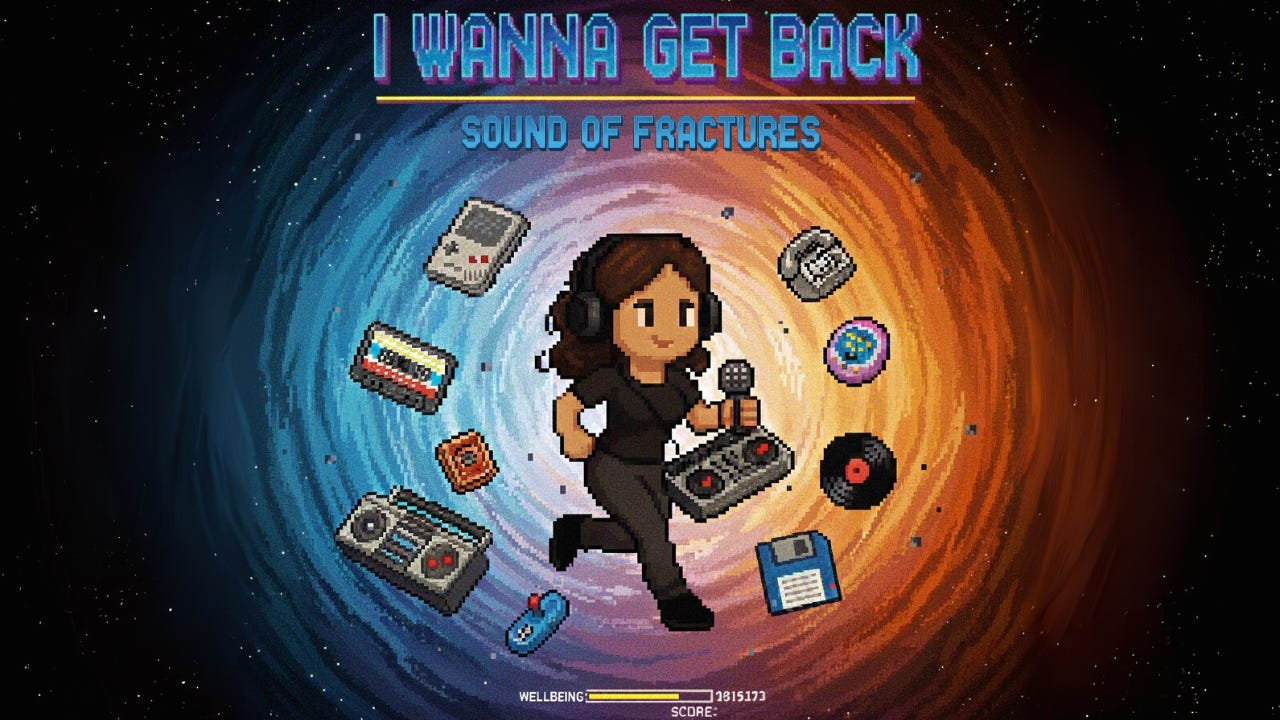
The new song sits in the similar conceptual space as SCENES: deeper connections. In this instance in stead of personal memories the glue became nostalgia, reflection, and wanting to return to what matters, inspired by a combination of the song feel and what was seeing happen around me:


During the lead up to the release, I kept seeing talk of how people were rediscovering old MP3 players and early-2000s tech, symbols of a slower and more tactile internet. I was having these same conversations with my friends too…


This combined with the recent narratives around how people are tiring of social media, as AI slop takes over, and the platforms gear their algorithms towards sales and away from connection… people are for the first time starting to switch off.
So I decided to build a small retro runner game around the release, with the aim of creating a different way for people to hear the song first and connect with it. But also to play with what I was seeing around me and have fun with it. It was a simple place to start for a vibe coding learning project, a way for people to play with the concept in the music, while hopefully connecting to the music… and maybe leave the doomscroll for 2 minutes.
PLAY ‘I WANNA GET BACK’
You play as a pixel DJ racing through a nostalgic landscape, collecting memories like MP3 players, vinyl, and photos, while dodging the digital noise that distracts you.
Finish a run and you can submit your score to the leaderboard, get a free download of the track, and even win daily merch.
A new kind of pre-release
The game arrives now a week before the song hits streaming, so you get to hear the song early and by entering your email and putting your initial on the score board as a thank you, you get a free download of the song.
It’s a small thank-you to the people who have been following and supporting my experiments, giving them early access to hear the track before anyone else.
It’s also a way to invite you into the world before it officially exists, to experience the story first.


Every day, the top of the leaderboard receives a limited-edition sticker sheet featuring characters and nostalgic items from the game.
And if you complete the game, you’ll be entered into a draw to win a copy of the SCENES: Prompts to Reflect postcard book, a direct link back to the project that started all of this.
Doing it myself
Unlike SCENES, I didn’t hire anyone.
I learned to make the game using AI-assisted tools like Cursor and Claude, building each part from scratch.
At first, it was chaos. Broken leaderboards, looping emails, and characters that refused to move. But slowly, it came to life.
I designed the pixel characters, generated the art and animations, pulled sound effects straight from the song’s stems, and set up automated systems that email players when they finish.
By the end, I had a playable world that connected back to the music both sonically and emotionally.
Why this matters
We keep being told that musicians need to become “content creators.”
But maybe what we really need is to become world builders, artists who build small, self-contained ecosystems around their ideas.
World-building lets us move beyond algorithms and metrics into something slower, stranger, and more human.
It asks: what does your music look like, feel like, and behave like, when you set it free from the timeline?
This game is my latest attempt to answer that question. It’s an experiment in how artists can build interactive, automated, emotionally connected experiences on their own terms, without waiting for permission or a budget.
The biggest challenge is to get anyone to click anything…… so have a go!
Play it now
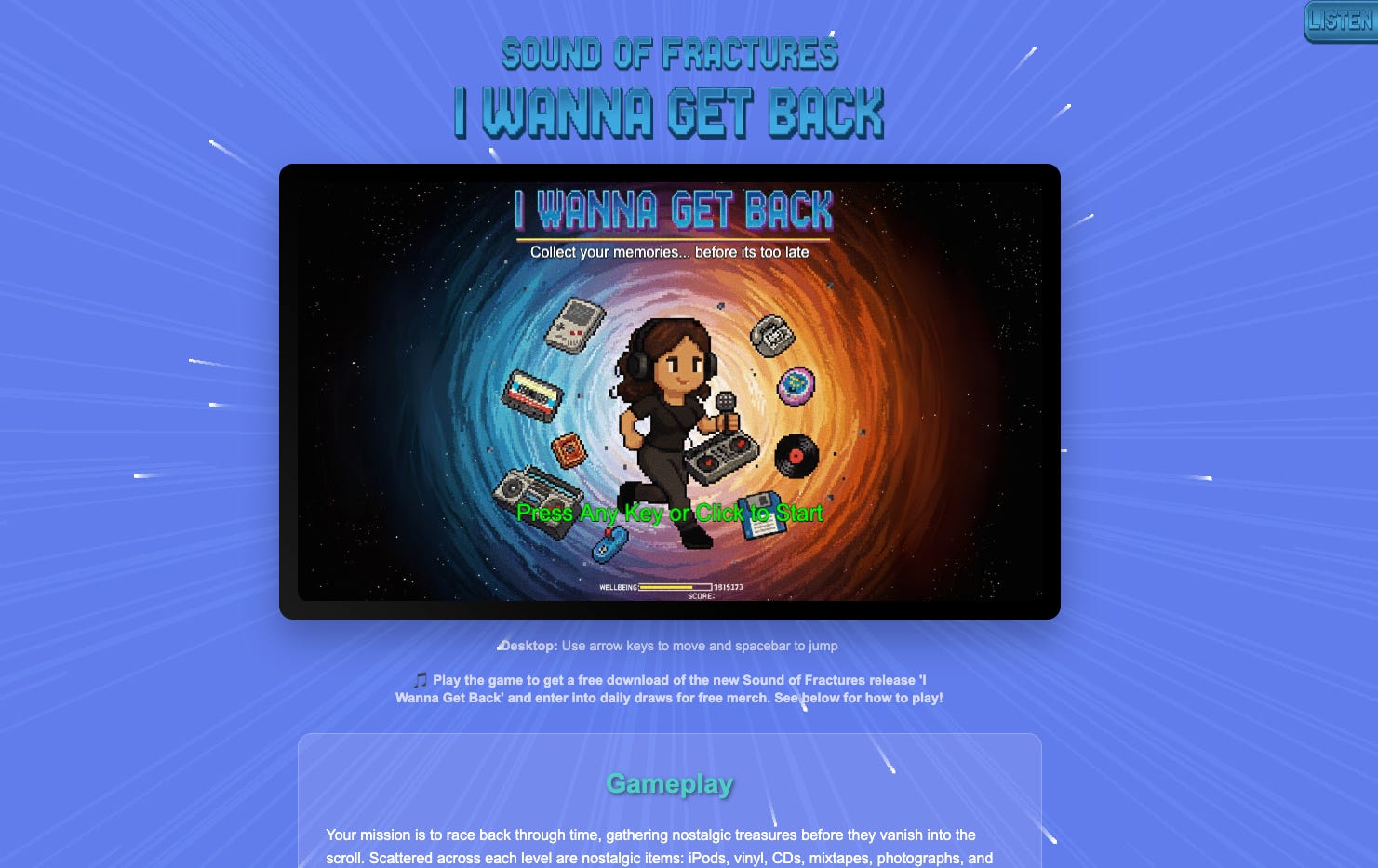
The I Wanna Get Back game is now live.
Play it, explore it, and tell me what you find in it.
You can climb the leaderboard, get the track early, and maybe even win some of the physical pieces that link this project back to SCENES.
Each Day the person at the top of the leader board will get win a limited edition sticker sheet, and if you can find a way to win the game you will get entered in the a dray for a free SCENES : Prompts To Reflect post card book worth £30
Because this isn’t just about a game.
It’s about testing what happens when artists start building their own worlds, one small experiment at a time.
Love this idea! I’ve met a few people who were creating zines and even a novel to go along with their release. Check out https://www.captainsunbeamuniverse.com/ the music is fantastic and the story they’re telling weaves together beautifully.
Personally I’m starting small and instead of selling physical media, I’m doing some of my own linocut printmaking that could stand on its own as a wall print, but fits the theme of the band. Plot twist, there’s an NFC tag on the back so when you want to listen to the album you tap the print with your phone :) currently links to Bandcamp but I’m hoping an alternative appears soon.
This is awesome, and so creative. I've been thinking about something very similar recently — the EP I released last Friday had a poem and a coloring book with it, all tied to the themes explored on the EP. The "world-building" frame was exactly what I was going for — very well put.